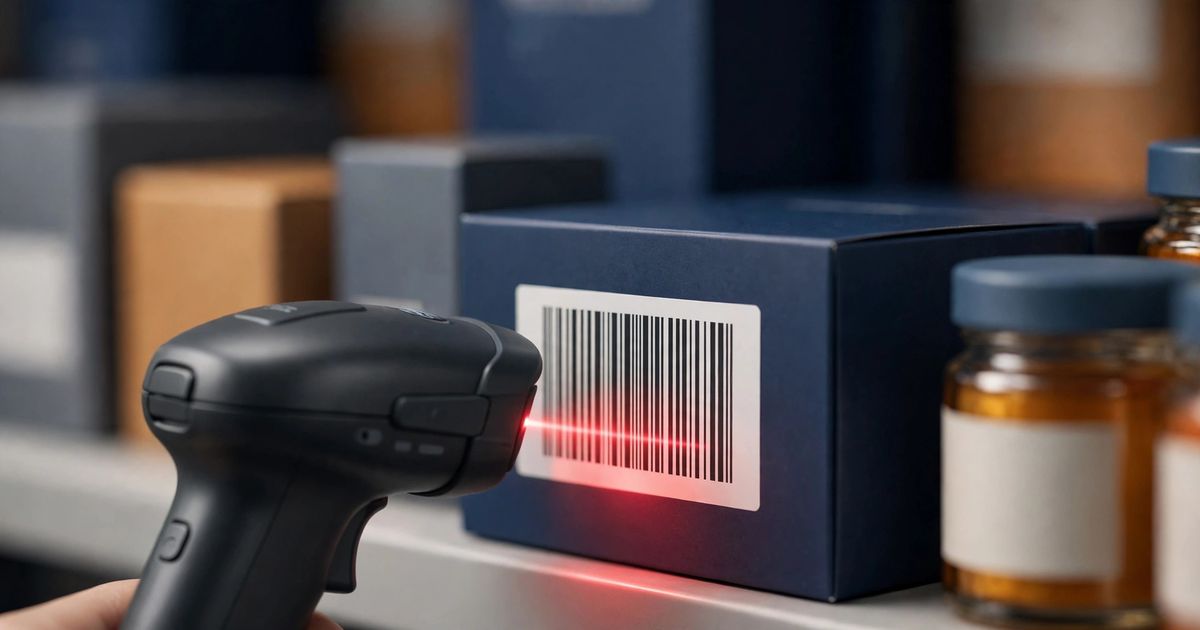
You're labeling your first product and hit the question every seller hits: UPC or EAN? Pick wrong and a retailer or marketplace can reject the listing — pick right and you never think about it again. The short answer: UPC-A if you sell only in the US and Canada, EAN-13 almost everywhere else. Here's how that breaks down in practice, because the details are where listings get stuck.
The 10-second decision:
- US/Canada stores only → UPC-A
- Anywhere else, or worldwide → EAN-13
- Tiny packaging → UPC-E / EAN-8
- Your own warehouse only → Code 128, no GS1 needed
UPC vs EAN at a glance
| UPC-A | EAN-13 | |
|---|---|---|
| Digits | 12 | 13 |
| Main region | United States & Canada | Europe and most of the world |
| Accepted | North America; increasingly elsewhere | Worldwide, including the US since 2005 |
| System | Both are GS1 GTINs — the same global system, one digit apart | |
| Small-package version | UPC-E (8 digits) | EAN-8 (8 digits) |
| Best for | US/Canada-only retail | International sales, marketplaces, future-proofing |
The thing most comparisons miss: these are not rival standards. A UPC-A is what an EAN-13 looks like when its first digit is 0 — the same number, the same check digit, read by the same scanners. If you want the technical side of how they're built and printed, our complete guide to UPC, EAN and Code 128 barcodes covers it in depth. In GS1 paperwork the same numbers are called GTIN-12 (the UPC-A) and GTIN-13 (the EAN-13) — marketplace seller docs usually use the GTIN names.
Which one do you need? By scenario
You sell only in the US or Canada, in physical stores. UPC-A is the traditional default and every North American checkout reads it. Either format technically works today, but UPC-A is what local distributors and label printers expect.
You sell internationally — or might one day. EAN-13. It's the native format in Europe, Asia, Australia and most other markets, and since 2005 US retailers have been required to accept it too. One number, every market, no relabeling when you expand.
You sell on Amazon or other marketplaces. What Amazon actually checks is that your number is a valid GTIN registered in the GS1 system — the barcode format follows from the number you're issued. Numbers bought from resellers often fail this check because the company prefix belongs to someone else. Get your prefix from GS1 directly.
Your packaging is tiny. Neither standard format fits well on a lip balm or a pen. That's what the 8-digit versions exist for: UPC-E in North America, EAN-8 elsewhere. Both compress the full number into a shorter symbol for small items.
The barcode never leaves your own warehouse. Then you don't need UPC or EAN at all. Internal labels — bins, shelves, asset tags — can use Code 128 with your own numbering, no GS1 registration required. Don't pay for a GTIN your stockroom doesn't need.
Three myths that cause real problems
"EAN barcodes don't work in America." Outdated. North American retailers have accepted EAN-13 at checkout since 2005. An EAN-13 with a leading digit other than 0 simply has no 12-digit twin — it scans as itself.
"I can buy cheap UPC numbers online." You can buy numbers — the problem is whose they are. Resold numbers trace back to another company's GS1 prefix, and marketplaces that verify against the GS1 registry will flag or reject them. The GS1 barcode standards exist precisely so every number maps to one accountable company.
"The format matters more than the number." Backwards. The number (your GTIN) is the asset; the barcode is just its printed form. The same GTIN-13 prints as EAN-13 anywhere, and as UPC-A in North America if it starts with 0.
"The first digits show where the product was made." They don't. The opening digits are the prefix of the GS1 organization the company registered with — a German-registered brand selling goods made in Vietnam still carries a German prefix. It identifies the brand owner's registration, not the factory.
What the number costs (the image is free)
Generating a barcode image costs nothing. The GTIN behind a retail barcode is licensed from GS1, and the price structure depends on how many products you have: GS1 US offers a single-GTIN license if you have just one product, while a company prefix — your own block of numbers — suits a growing catalogue and is priced by catalogue size with an annual renewal. Prices vary by country, so check your national GS1 organization rather than a reseller site.
Once you've chosen: make the barcode
However you get your number, the image itself is the easy part. Enter it into a free barcode generator, pick UPC-A or EAN-13, and the check digit is calculated and shown before you download — so what scans is never a surprise. Export as SVG for print artwork, print one test label at actual size, and scan it with a phone before committing to a full run.
FAQ
Can I use an EAN-13 in the United States?
Yes. US and Canadian retailers have accepted EAN-13 since 2005. It scans as a 13-digit number; nothing needs converting.
Can a UPC-A be used outside North America?
Usually yes — most modern scanners read it, and it's understood internationally as the EAN-13 form with a leading 0. But if you're printing labels specifically for non-US markets, EAN-13 is the safer native choice.
Which is better for Amazon?
Neither format wins — validity does. Amazon verifies your GTIN against the GS1 registry, so a GS1-issued number in either format passes, and a resold number in either format can fail.
Do I need a different barcode for every product variant?
Yes. Every size, color, and pack quantity is a separate trade item and needs its own GTIN — one number per variant, not one per product line.
UPC or EAN for a product sold worldwide?
EAN-13. It's native in most markets and accepted in North America, so a single number and label design works everywhere.
Do I need a UPC to sell on my own website?
No. Your own store can run on SKUs you invent yourself. A UPC or EAN only becomes necessary when a retailer or marketplace — Amazon, Walmart, eBay — requires a GTIN for the listing.
How much does a UPC barcode cost?
The image is free. The number is licensed from GS1: a single GTIN covers one product if that's all you need, and a company prefix covers a whole catalogue with an annual renewal. Exact fees vary by country and catalogue size.




Comments
No comments yet. Be the first to share your thoughts below.